Against The Hype

On good movies that linger, and great ones that don't
Subscribe

Archive for the ‘Full Essays’

My Best Shot: A Streetcar Named Desire

March 23, 2011 By: Colin Low Category: Full Essays

I’ve tried. I swear I’ve tried. But after numerous repeated viewings, I still look upon Vivien Leigh’s Blache DuBois in A Streetcar Named Desire and wonder what gains the feisty, ever resourceful Scarlett O’Hara thinks she’ll get out of posturing so self-consciously and pitching her voice around the range of a twittery coo. It’s a testament to Leigh’s legendary performance as that other Southern belle in Gone with the Wind that it haunts this role too. Yet Leigh is so much more stiffly heightened here, even while keeping within a similar vein of theatricality, that we can’t quite say she’s approaching Blanche as an aged, more destitute remainder of who Scarlett once was either (though now that I would’ve liked to see).

(more…)

Guns and Poses: All That The Matrix Allows

November 01, 2010 By: Colin Low Category: Full Essays

The Matrix’s obsession with binaries of costume, group size, violence, sets and props seems to establish it as a rudimentary us-versus-them fantasy of anti-authoritarianism. But unsettling visual parallels linger between its ostensible heroes and villains, driving us to ask if the rebels might not be shackled to enacting a violence as fascistic as the system they are fighting.

The movie aligns us early to both Neo and Trinity by pitting them separately against similar groups of uniformed pursuers. Cornered respectively in a fleabag hotel and in a maze of sterile office cubicles, Trinity and Neo each find themselves approached by policemen and Agents, who enter these scenes sharing space in shots with at least one similarly uniformed colleague (be it police uniform or Agent’s Secret Service suit). Through this visual grouping and their uniforms’ associations with legal authority, the policemen and Agents lose much of their individuality, seeming to hail from a vast conspiratorial network further implied in the Agents’ earpieces. We thus identify with the outnumbered individual in these scenes as they attempt to escape their omnipresent foes and unappealing environs.

As if to confirm our suspicions, the Agents and rebels proceed to subject Neo’s body to dichotomous extremes of physical violence, with contrasting resources at their disposal. When Agent Smith’s deal with Neo falls through, Neo’s mouth magically seals upon a cutaway from the smirking Smith, suggesting the Agent’s gleeful, inexplicable power to silence Neo. His colleagues pinning Neo down, Smith then activates a metal capsule that grows into a spindly, leg-splaying metallic virus that clambers into Neo’s navel as he struggles. By contrast, the rebels’ equipment is relatively low-tech, and their violence harmless: the device Trinity uses to extract the virus is ramshackle and ungainly, and the interior of Morpheus’ ship looks like an industrial basement with old barber’s chairs. Furthermore, the weapons-free fight between Morpheus and Neo, involving parries and near-miss fists, is benignly instructional, while Neo’s failure to leap across buildings is met merely with a rippling asphalt trampoline upon first impact, even as the blunt second impact reiterates the stakes of failure against their enemies. We are thus conditioned to continue seeing the rebels as underdogs and enablers against the oppressive Matrix and its Agents.

However, multiple images within Neo and Trinity’s subsequent rescue of Morpheus invite a troubling comparison between the Agents and themselves. “Dodge this,” says Trinity before shooting an Agent in the head, adopting the very pose taken by a simulacrum of Agent Smith earlier in Neo’s training.  (more…)

The Best Shots of A Face in the Crowd

September 02, 2010 By: Colin Low Category: Full Essays

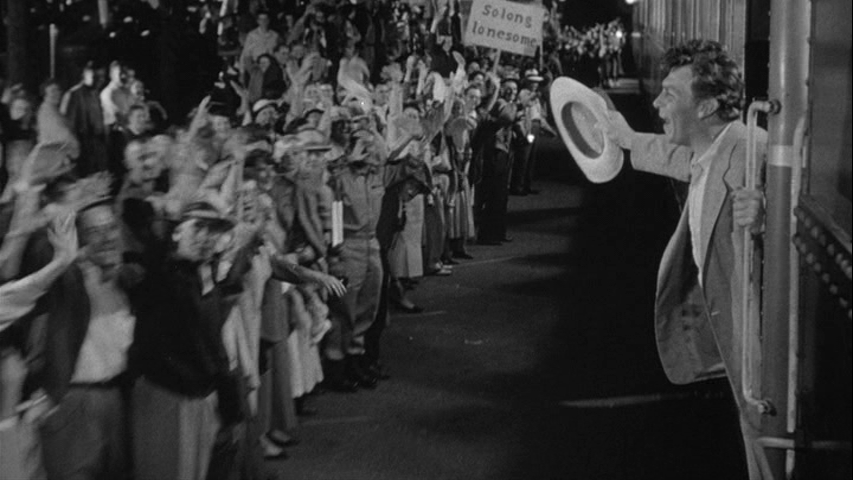
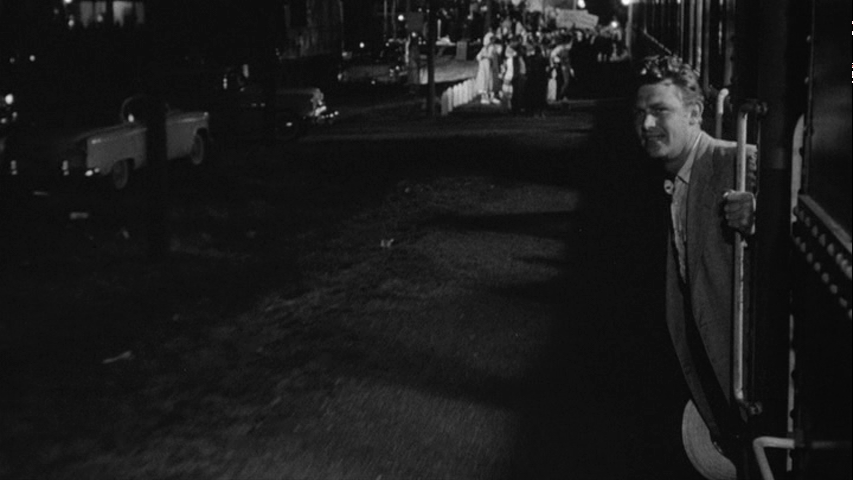
A Face in the Crowd asks Andy Griffith to embody Larry “Lonesome” Rhodes, a sort of barnstorming hick that rouses the nation over the airwaves (first by radio, then by TV) with his lack of pretense. But it’s hard to know what’s more condescendingly offensive: that his schtick works as it does, with all these fawning reaction shots of “aw-shucks” Americans in their old-fashioned living rooms and kitchens, smitten with a voice that finally speaks for them; or that Lonesome finally succumbs to corruption, like all star-is-born types inevitably do (or at least the males, those power-starved horndogs!). Worse, in order to fell him, the movie resorts to the cheap trick of having him learn to despise the masses who love him, and spout his disdain just when he thinks they aren’t listening. One would think he, of all people, would know how they hang onto every word. (more…)

Review: (500) Days of Summer

November 05, 2009 By: Colin Low Category: Full Essays

500-days-of-summer

Despite the title, (500) Days of Summer is not about a sunny romance, as the narrator is quick to warn you. “This is not a love story,” he intones, and he’s probably referring to the routine heartbreak in movies that accompanies any belief in love. But he’s also right about the relationship at this movie’s core not being about love. See, there are two kinds of romantic comedies in this world: the ones that divide people into Men and Women, and the ones that don’t. (500) Days of Summer hastily identifies itself as one of the former, in a kitschy montage that narrates how Joseph Gordon-Levitt (the Man) believes in love, and how Zooey Deschanel (the Woman) turns heads wherever she goes. How are you supposed to react to a montage like that? He’s the guy of this movie, and she’s the girl: they’re going to fall in love.

Except they don’t. From Day (1) that Deschanel’s character waltzes into mopey office-cubicle hipster Tom’s life, his eyes follow her in slow-mo as it dawns upon him that she’s the girl of his dreams. Days later, when she identifies The Smiths through his headphones and gushes about the band, that’s confirms it. So when she keeps not asking him out, and later tells him that she isn’t looking for anything serious, it floats right past Tom’s rose-tinted sensors even as we’re clenching our fists in exasperation, and things go predictably downhill from there. (500) Days of Summer has been dubbed an anti-rom-com, but it deserves that label not because the two leads don’t end up together, but because it’s an unromantic study of infatuation at its most blinkered.

(more…)

Besotted with Stars: The Problem with WALL·E

October 09, 2009 By: Colin Low Category: Full Essays

This piece was written as an entry for Pixar Week over at The House Next Door. For other critical analyses of Pixar’s work, please head over there and have a look!

walle2

For all that Pixar loves to celebrate its underdogs, WALL·E marks the first (and so far, only) time the studio has named an entire movie after its protagonist, neither effacing him into part of a wider community (Toy Story, A Bug’s Life, Monsters Inc., The Incredibles, Cars) or a central mission (Finding Nemo, Ratatouille, Up). That WALL·E’s name is shared by his peers and short for his mission—”Waste Allocation Load Lifter · Earth-class”—barely counts against this claim, since the acronym is pronounced like a regular human name; the movie is built on the premise that he is the last of his kind; and the essential pleasures of WALL·E do not spring from his assigned mission but in the tangents he chases beyond it. Though the break in titling scheme alone implies it, we can tell from the raves accompanying the movie’s prologue—in which WALL·E is only character we encounter, save for a curly-feelered roach—that Pixar invests much of WALL·E’s success on the cult of personality that forms around its title character.

And what a personality! Binocular eyes that pivot as though they were brows; a stocky frame into which he can retract like a tortoise; a symphony of blips, squeaks and squalls: all these feats of character design conspire to make WALL·E as expressive as a droid could realistically be. Left to clean up a trash-strewn Earth, WALL·E splits his time between compacting trash and unearthing lost reminders of humanity’s technological gifts from the rubble. He has a child’s fascination with simple interactive objects: it is endearing to watch him handle sporks, hubcaps, whisks, fire extinguishers and even brassiere in unexpected ways (or bubble wrap in an expected, universally beloved way), collecting and playing with them as though they were the peaks of our civilisation. Maybe they are. (more…)